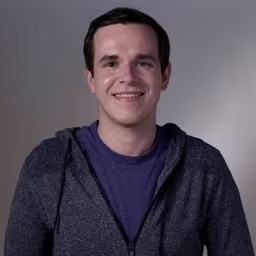
Ryan Marcus, assistant professor at the University of Pennsylvania.
Using machine learning to build the next generation of data systems.
    ____                       __  ___
   / __ \__  ______ _____     /  |/  /___ _____________  _______
  / /_/ / / / / __ `/ __ \   / /|_/ / __ `/ ___/ ___/ / / / ___/
 / _, _/ /_/ / /_/ / / / /  / /  / / /_/ / /  / /__/ /_/ (__  )
/_/ |_|\__, /\__,_/_/ /_/  /_/  /_/\__,_/_/   \___/\__,_/____/
      /____/
   ___                   __  ___
  / _ \__ _____ ____    /  |/  /__ ___________ _____
 / , _/ // / _ `/ _ \  / /|_/ / _ `/ __/ __/ // (_-<
/_/|_|\_, /\_,_/_//_/ /_/  /_/\_,_/_/  \__/\_,_/___/
     /___/
   ___  __  ___
  / _ \/  |/  /__ ___________ _____
 / , _/ /|_/ / _ `/ __/ __/ // (_-<
/_/|_/_/  /_/\_,_/_/  \__/\_,_/___/
Rethinking Execution Engines for Modern Architectures
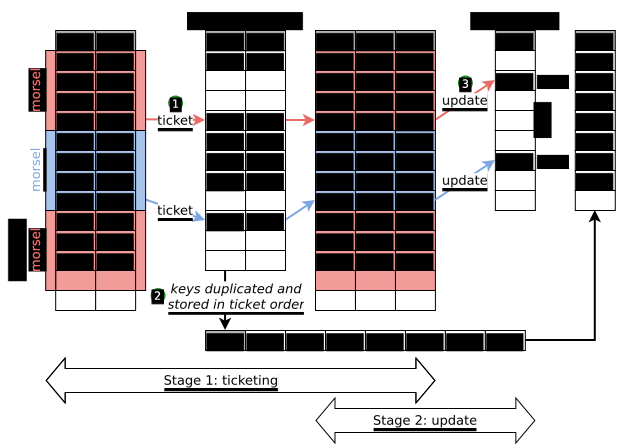
The execution engine is the muscle of a database system, and most execution engines were designed for hardware architectures and user workloads that are no longer dominant. As hardware platforms get more concurrency, different tiers of memory, and increasingly heterogeneous architectures, it’s time to rethink how we design and optimize execution engines for modern, agentic, and long-running workloads.
Papers
- Ultron: History-Based Query Optimization at Databricks
- Supun Nakandala
- RK Korlapati
- Eric Liang
- Yunjia Zhang
- Yuhao Zhang
- Andrey Gubichev
- Kelvin Jiang
- Yannis Sismanis
- Mostafa Mokhtar
- Sid Taneja
- Vuk Ercegovav
- Amir Hormati
- Amit Shukla
- Michalis Petropoulos
- Reynold Xin
- Ryan Marcus
VLDB '26 (pdf) (doi)
- Global Hash Tables Strike Back! An Analysis of Parallel GROUP BY Aggregation
- Daniel Xue
- Ryan Marcus
VLDB '26 (pdf) (doi)
Preprints
“Piece of CAKE: Adaptive Execution Engines via Microsecond-Scale Learning.” Zijie Zhao, Ryan Marcus. Posted arXiv preprint ‘26. (doi)
“Tailwind: A Practical Framework for Query Accelerators.” Geoffrey X. Yu, Ryan Marcus, Tim Kraska. Posted arXiv preprint ‘26. (doi)
People